White Tower
Overview
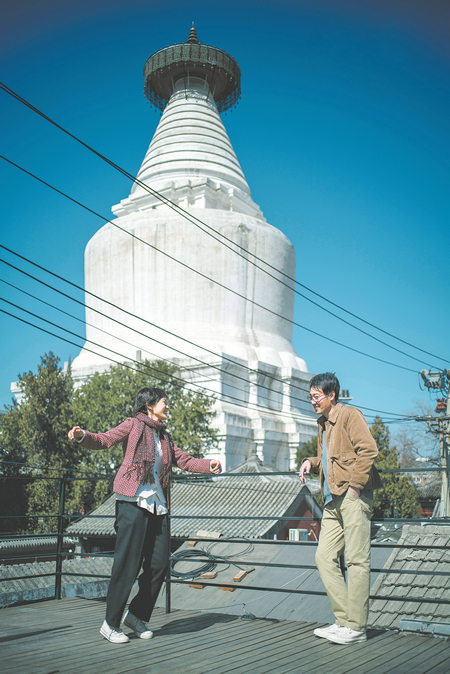
The White Pagoda, or White Stupa, is an iconic historical and cultural landmark located in Beijing. It is situated within the Miaoying Temple, a significant religious site in the city. The White Pagoda of the Miaoying Temple was completed during the Yuan Dynasty (1271-1368) and was designed by the Nepalese architect Araniko (1245-1306). It is elevated on a 2-meter-high platform that occupies an area of more than 1,400 square meters. The stupa's 9-meter-high base consists of three tiers, of which the upper two are designed as Sumeru terraces, an architectural style originating from Indian Buddhism and widely adopted in East Asia with a meaning of supreme stability. Each tier is bilaterally symmetrical and designed with origami edges along its four sides.
The main body of the White Pagoda resembles a giant inverted bowl. At the juncture of the stupa body and its base, a lotus throne featuring 24 upturned carved lotus petals makes a natural transition between the two parts. The xianglun rings, a cone-shaped vertical shaft with 13 tiers of rings piling up in decreasing diameter to the top, hold up the canopy and the gilded bronze finial.
The White Pagoda of the Miaoying Temple was the greatest work of Araniko and is the only well-preserved cultural relic of the Dadu capital of the Yuan Dynasty in Beijing. It is a tribute to the historical friendship between China and Nepal.
Architectural Significance
The White Pagoda has played a central role in various cultural representations, including its feature in director Zhang Lu's film "The Shadowless Tower", which competed for top awards at the 73rd Berlin Film Festival. The film explores Beijing's culture and the impact of its unique characteristics on its residents, with scenes shot in the streets and architecture surrounding the White Pagoda.
The White Pagoda stands out prominently within the urban context of Beijing due to its distinctive white color. This architectural feature contrasts sharply with the prevailing gray and brownish-red hues of the city's traditional buildings. The pagoda's unique appearance not only adds to the skyline of Beijing but also plays a significant role in cultural and historical narratives of the area, providing a visual focal point for both locals and visitors.
Tourist Attraction
The White Pagoda is a popular tourist attraction, drawing visitors who are interested in exploring Beijing's historical and cultural heritage. The surrounding area is rich in historical architecture and natural beauty, making it an ideal destination for those wishing to experience the fusion of Beijing's ancient and modern elements.
During spring, the area around the White Pagoda comes alive with blossoms, providing a picturesque setting that has been cherished by photographers and visitors alike. The pagoda's presence among the floral beauty of Beijing reinforces its status as a symbol of the city's dynamic and ever-changing cultural landscape. Article reference1. The White Stupa of the Miaoying Temple, Beijing. chinaservicesinfo.com. 20222. A budding attraction. chinadaily.com.cn. 2021Photo Gallery(2 pictures)CategoriesCultural HeritageTagHistorical BuildingCultural LandscapeCity TourismCatalogue1. Overview2. Architectural Significance3. Tourist Attraction- - - []








